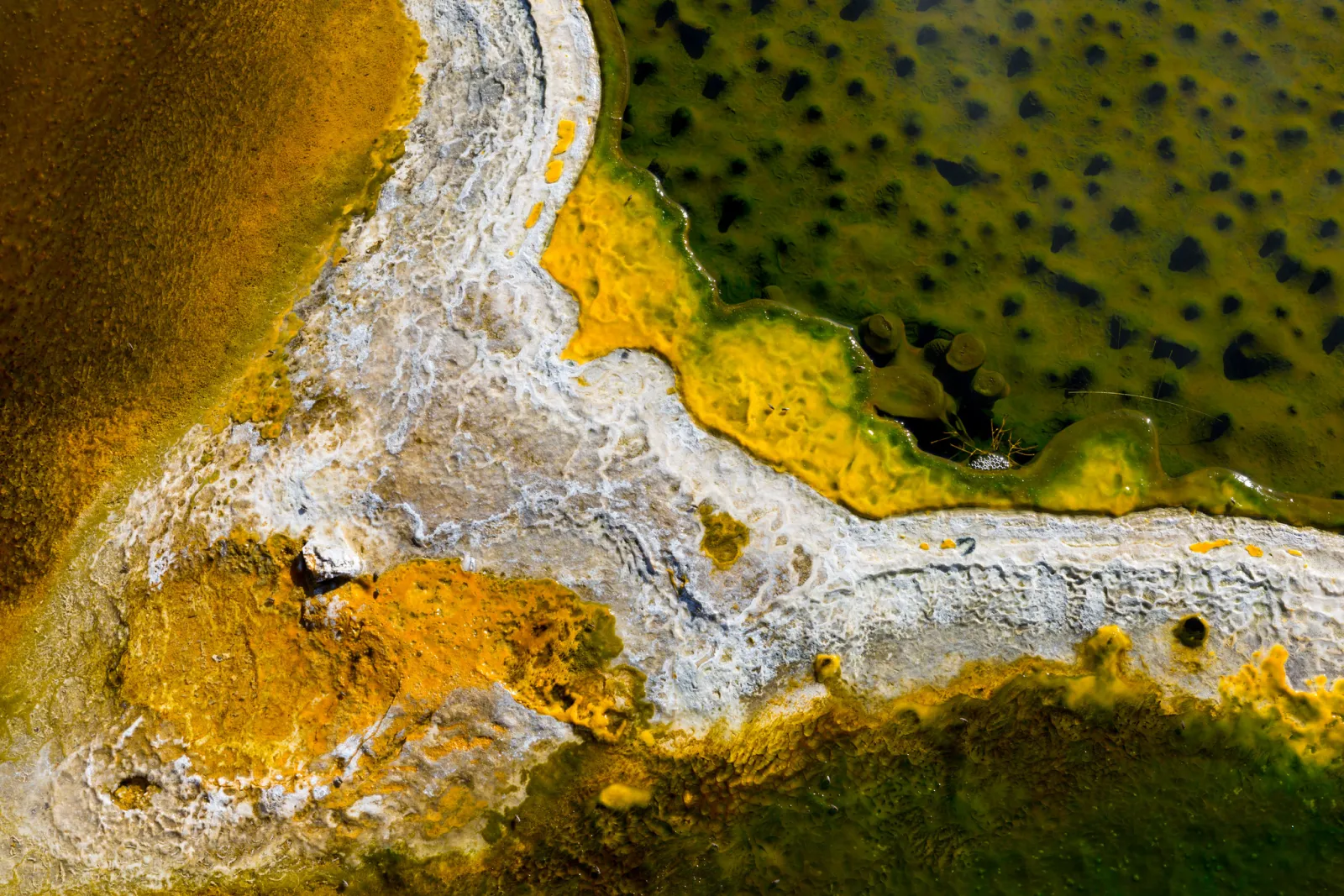
It is believed that cyanobacteria played a major role in generating the oxygen atmosphere of the Earth.
Found in habitats ranging from the hot pools of Yellowstone to the deserts of the Middle East to the middle of the oceans, cyanobacteria are nearly ubiquitous on the Earth’s surface. They have adapted to grow in fresh water, salt water, brackish water, desert crusts, in snow and ice, at sea level and at high elevations.
Sometimes known as blue-green algae, cyanobacteria produce blooms, large floating masses that appear as blue-green mats in the water surface. Some blooms in the oceans are thousands of miles long. The size, duration and range of blooms are increasing with increased pollution and warming planetary temperatures.
Some species of cyanobacteria are symbiotic, meaning that they live inside of other organisms. Our initial research at Brain Chemistry Labs focused on cyanobacteria that live inside specialized roots of cycad plants. These symbiotic cyanobacteria fix nitrogen and may aid in the nitrogen metabolism of the plant. But they also produce toxins, such as BMAA.
BMAA was discovered when Brain Chemistry Labs scientists were investigating the causes of a fatal illness among the Chamorro people of Guam. More than 25% of adults in two villages perished from a disease that has ALS, Parkinson’s, and Alzheimer’s disease symptoms, a syndrome later named ALS/PDC or lytico bodig.
The Chamorro people ate flying foxes as a delicacy. Scientific analysis revealed that the flying foxes contained high concentrations of BMAA. The BMAA had bioaccumulated in the bats from when they fed on the seeds of cycad trees that had symbiotic cyanobacteria in their roots.
Although first identified on Guam, it was later discovered that BMAA is produced by nearly all cyanobacterial species[1]. BMAA can biomagnify up the food chain[2][3] and result in higher concentrations within filter-feeding or bottom-feeding shellfish that live beneath cyanobacterial blooms.
We recently reported that dolphins in Florida accumulate BMAA in their brains, with neuropathology and gene expression similar to Alzheimer’s disease[4].
We also reported the presence of BMAA in the lungs of patients with ALS and Alzheimer’s disease. We identified BMAA in dust particles from the Great Salt Lake’s dried lakebed, raising possible health concerns for those exposed to windblown dust along the Wasatch Front[5]. Follow-up studies showed BMAA and its isomers are aerosolized[6], which likely explains why people living on the leeward side of water bodies are at a greater risk for contracting ALS. It also might explain why Gulf War veterans are 2.5 times more likely to contract ALS than the general population.
Join us in supporting this highly impactful work.
- 1.
Diverse taxa of cyanobacteria produce β-N-methylamino-l-alanine, a neurotoxic amino acid. PNAS. doi:10.1073/pnas.0501526102
- 2.
A mechanism for slow release of biomagnified cyanobacterial neurotoxins and neurodegenerative disease in Guam. PNAS. doi:10.1073/pnas.0404926101
- 3.
Dunlop RA, Cox PA, Banack SA, Rodgers KJ. The non-protein amino acid BMAA is incorporated into human proteins in place of L-serine causing protein misfolding and aggregation. PLOS ONE. 2013;8:e75376. doi:10.1371/journal.pone.0075376
- 4.
Noke Durden W, Stolen MK, Garamszegi SP, Banack SA, Brzostowicki DJ, Vontell RT, Brand LE, Cox PA, Davis DA. Alzheimer’s disease signatures in the brain transcriptome of Estuarine Dolphins. Communications Biology. 2025;8:1400. www.nature.com/articles/s42003-025-08796-0
- 5.
Metcalf JS, Banack SA, Cox PA. Cyanotoxin Analysis of Air Samples from the Great Salt Lake. Toxins. 2023;15(11):659. doi:10.3390/toxins15110659
- 6.
Metcalf JS, Aparicio M, Banack SA, Pim J, Cassani JR, Cox PA. Developing Tools to Assess Airborne Cyanobacterial Toxins in Southwest Florida, USA. Toxins. 2026;18:309. doi:10.3390/toxins18070309
BMAA
First found in the cycads of Guam. Produced by nearly all cyanobacterial species, and now detected in shellfish, dolphins, human lungs, lakebed dust and the air.
- ProducerNearly all cyanobacteria
- RouteFood chain, dust, air, water
- FoundEverywhere
- FilmToxic Puzzle